

A dispatcher offers you a truck for tomorrow's pickup. The MC Number is active, the insurance certificate looks fine, and the rate is competitive. You send the rate confirmation. The next morning, a truck arrives with a different company name on the door. The driver has the correct pickup number, but nobody at your brokerage approved a carrier change.
This is exactly why understanding how to avoid double brokering takes more than an MC lookup. Before assigning freight, confirm that the dispatcher represents the registered motor carrier, verify who will actually transport the load, and make sure the shipper knows which carrier is authorized to collect it.
A real MC Number can be used by someone who has no connection to the company that owns it. An active authority record proves the company is authorized for certain operations. It does not prove the person emailing you has permission to book its trucks.
This guide covers the verification steps worth completing before tendering freight, the contact and equipment discrepancies that deserve attention, and what to do when a carrier's information changes after booking.
How to Avoid Double Brokering: Quick Pre-Booking Checklist
Before sending a rate confirmation to a new carrier, answer three questions.
Is this the correct legal business?
The company name, Motor Carrier (MC) Number, and USDOT Number should match official registration information and the onboarding documents.
Does this person actually represent the carrier?
The dispatcher should be someone the motor carrier recognizes and authorizes to accept freight.
Is the approved carrier going to move the load?
The company accepting the transportation should be connected to the truck and driver arriving at pickup, or any different arrangement must be properly disclosed and authorized.
A clean federal record is only the beginning.
Complete these checks before approval:
-
Match the MC Number with the carrier's legal business name.
-
Confirm the associated USDOT Number.
-
Check that the required Operating Authority is active.
-
Review current insurance filings.
-
Verify the Certificate of Insurance through an independently established agent or insurer contact.
-
Compare the dispatcher's email address and phone number with established carrier information.
-
Call the company using a number you verified independently.
-
Confirm the dispatcher is authorized to book the load.
-
Establish which motor carrier will physically transport the shipment.
-
Obtain driver and equipment information before pickup when available.
-
Give the shipper the approved carrier's identification details.
-
Require verification before accepting any carrier or equipment substitution.
A dispatcher may not know the final tractor number when first offering a truck. That happens during normal operations.
The problem arises when the transportation arrangement changes and the approved carrier cannot confirm it.
Double Brokering Prevention Checklist
| Verification Area | Acceptable Result | Reason to Hold the Load |
|---|---|---|
| MC and USDOT Number | Both identify the intended motor carrier | Identifier belongs to an unrelated business |
| Operating authority | Required motor carrier authority is active | Authority is inactive, revoked, or pending |
| Insurance | Relevant filings and coverage are confirmed | Policy or required filing cannot be verified |
| Dispatch contact | Carrier confirms the person is authorized | Carrier does not recognize the dispatcher |
| Email domain | Address is established or independently confirmed | Unexplained domain or contact change |
| Truck assignment | Approved carrier confirms driver and equipment | Unverified carrier substitution |
| Rate confirmation | Issued to the correct contracting carrier | Unexpected request to change carrier identity |
| Pickup authorization | Shipper knows which carrier is approved | Arriving equipment cannot be reconciled |
Use the same approval process for every unfamiliar carrier.
If documents are incomplete, mark the carrier pending. If the company lacks the required authority or the booking contact cannot be authenticated, do not release the load.
Do not turn every mismatch into an accusation. Resolve it through independent verification.
What Is Double Brokering and Why Is It Dangerous?

Double brokering commonly refers to a situation where a carrier or intermediary accepts freight and then improperly transfers the transportation arrangement to another party without the necessary permission or disclosure.
For a freight broker, the immediate problem is losing control over who is actually moving the shipment.
Consider how an unauthorized transfer can develop.
Your brokerage approves a carrier, checks its FMCSA records, confirms insurance, and issues a rate confirmation.
Instead of transporting the freight, the contracting party arranges for another trucking company to pick it up.
The original broker may not know another carrier has been assigned.
The second trucking company may believe it accepted a legitimate load from an authorized intermediary.
The freight might even arrive on time.
But the arrangement creates problems that can surface during transit, delivery, or payment.
The actual carrier was not approved.
The business moving the freight may never have completed your onboarding process.
You may not have reviewed its authority, insurance, or safety information.
Insurance may not match the transportation.
The certificate reviewed during booking belongs to the original carrier.
If another company moves the load, questions can arise about which policy applies and who is responsible for a loss.
Payment responsibility becomes disputed.
The original broker may pay the contracting carrier while the trucking company that performed the transportation claims it remains unpaid.
Pickup information can be misused.
In an identity theft or cargo fraud situation, an unauthorized party may use legitimate pickup details to collect freight.
Not every improper transfer involves theft. Some cases develop from undisclosed subcontracting, poor communication, or inaccurate representations about who accepted the load.
The broker still needs to establish which transportation party was approved and which one performed the shipment.
The Difference Between Co-Brokering and Illegal Double Brokering
Co-brokering and unauthorized double brokering are not the same thing.
Co-brokering generally involves properly authorized brokers participating in a transportation arrangement with the necessary contractual permission and defined responsibilities.
For example, a broker may have an agreement allowing another registered property broker to help arrange transportation.
The parties should understand who is responsible for arranging the load, which motor carrier will transport it, and how payment and records will be handled.
Unauthorized double brokering involves an improper transfer that lacks required authorization or conflicts with the representations, agreements, or applicable regulatory requirements.
A carrier may accept a shipment as the motor carrier and then pass it to another business without the original broker's approval.
However, not every use of another truck automatically makes an arrangement illegal.
Federal brokerage regulations distinguish brokers, motor carriers, and bona fide agents in specific circumstances. The actual transportation obligation, authority, contracts, and conduct matter.
Before approving an arrangement involving more than one transportation business, establish:
-
Which company accepted the load.
-
Which party has broker authority.
-
Which company holds the applicable motor carrier authority.
-
Who will physically transport the freight.
-
Who authorized the arrangement.
-
Which company is responsible for payment.
-
What insurance and contractual requirements apply.
-
Which entities should appear on the shipping documents.
If the arrangement differs from the original booking, resolve it before pickup.
Do not accept an unfamiliar dispatcher's statement that the change is normal practice as sufficient authorization.
How Double Brokering Can Affect Freight Payments
Payment problems sometimes appear only after delivery.
Your brokerage may receive the signed proof of delivery, process the contracted carrier's invoice, and consider the shipment complete.
Then another trucking company contacts accounting.
It claims it physically transported the load but was hired through an intermediary that has not paid it.
The second carrier may provide a bill of lading and delivery documents showing its truck or driver.
Now the parties disagree about the payment arrangement.
A signed proof of delivery confirms aspects of the transportation, but it does not automatically resolve competing payment claims.
Review the entire transaction:
-
Original carrier agreement.
-
Rate confirmation.
-
Dispatch correspondence.
-
Bill of lading.
-
Proof of delivery.
-
Carrier invoices.
-
Factoring instructions.
-
Payment records.
Identify which business contracted with whom.
Do not make assumptions about payment responsibility solely because a company appears on a delivery document.
The applicable agreements and circumstances need to be reviewed.
This is one reason to verify carrier identity before pickup rather than waiting until a payment dispute reveals another company was involved.
Key Red Flags of Double Brokering Schemes
Double brokering concerns often emerge from inconsistent contact information, unexplained equipment changes, or unusual pressure to bypass onboarding.
Fraudulent paperwork does not always look obviously fake.
An impersonator may use the real legal name, MC Number, USDOT Number, and address of an established carrier.
The important question is whether the person controlling the booking is connected to that business.
Mismatched Contact Details and Spoofed Domains
An email address can look convincing without belonging to the motor carrier.
A dispatcher might use a display name matching a legitimate company while the actual email domain contains an extra word, a changed letter, or an unfamiliar extension.
That difference can be easy to miss when a broker is reviewing several offers at once.
Check the complete contact information:
-
Sender email address.
-
Reply-To address.
-
Company email domain.
-
Telephone number in the signature.
-
Previous verified dispatch contacts.
-
Business information in the carrier packet.
-
Independently established company contact details.
A small trucking company using Gmail or another general email service is not automatically suspicious.
Many owner-operators operate without a dedicated company domain.
The question is whether the carrier confirms that the contact is authorized.
What to do
Find a company telephone number independently.
Call the motor carrier.
Identify the dispatcher offering the load and ask whether that person has authority to book transportation for the business.
Also confirm that the company expects to haul the shipment.
What a good result looks like
An authorized carrier representative confirms the dispatcher's identity and the proposed booking.
What to watch for
The representative does not recognize the person, the dispatcher refuses an independent callback, or the contact information changes repeatedly during onboarding.
Keep the load pending until the discrepancy is resolved.
Recently Issued Authority and Chameleon Carriers
New motor carriers are not inherently suspicious.
Many legitimate trucking businesses begin with a single truck, a recently issued authority, and limited inspection history.
However, fewer historical records mean a broker has less information to review.
That makes consistent identity and authority verification especially important.
Review these details:
-
Legal business name.
-
Registration history.
-
Current authority status.
-
Business location.
-
Contact information.
-
Reported power units.
-
Available inspection records.
-
Recent changes in registration details.
-
Unexplained relationships with other carriers.
What is a Chameleon Carrier?
A Chameleon Carrier generally refers to a motor carrier attempting to continue operations under another identity to avoid regulatory consequences or oversight.
Potential indicators may include overlapping company officials, telephone numbers, addresses, equipment, or operating locations associated with another carrier.
Those details require context.
Two legitimate trucking businesses may share a warehouse, dispatch office, or commercial address.
A company may change ownership or reorganize.
An address match does not prove wrongdoing.
Ask for an explanation and supporting records when the relationship matters to your approval decision.
Do not label a company fraudulent based only on shared information or a short operating history.
Rates Well Below Market and Pressure to Dispatch Fast
A low rate is not proof of double brokering.
A carrier may need a return load, have equipment close to pickup, or prefer a particular lane.
The concern increases when unusual pricing comes with pressure to skip verification.
For example, an unfamiliar dispatcher offers a significantly lower rate than other available trucks.
The person insists the truck is already moving toward the shipper and says there is no time to complete the normal insurance and contact checks.
That is a reason to hold the booking.
Other warning signs include:
-
Repeated requests for a rate confirmation before onboarding is complete.
-
Refusal to provide an independently verifiable company contact.
-
Resistance to insurance confirmation.
-
Demands for pickup numbers before carrier approval.
-
Unexpected changes to the legal carrier name.
-
Requests to send payment to an unrelated entity.
-
Inconsistent explanations about the truck assignment.
A busy lane or difficult pickup appointment does not change the required approval process.
If the carrier cannot be verified in time, use another approved option or address the appointment with the shipper.
Additional Warning Signs at Pickup
Not every identity problem is visible during booking.
Sometimes the first discrepancy appears when the truck arrives at the loading dock.
Watch for:
-
USDOT markings that differ from the approved carrier.
-
A driver identifying another trucking company.
-
An unannounced tractor or trailer substitution.
-
A driver who cannot identify the approved contracting carrier.
-
Conflicting pickup instructions from separate dispatch contacts.
-
A request to change the carrier name after arrival.
Equipment substitutions can be legitimate.
A tractor can break down. A driver can become unavailable.
The correct response is to verify the substitution through the approved motor carrier.
Do not approve the change solely because the arriving driver has a pickup reference.
Ask the shipper to hold loading until the discrepancy is resolved.
Step-by-Step Carrier Vetting Process
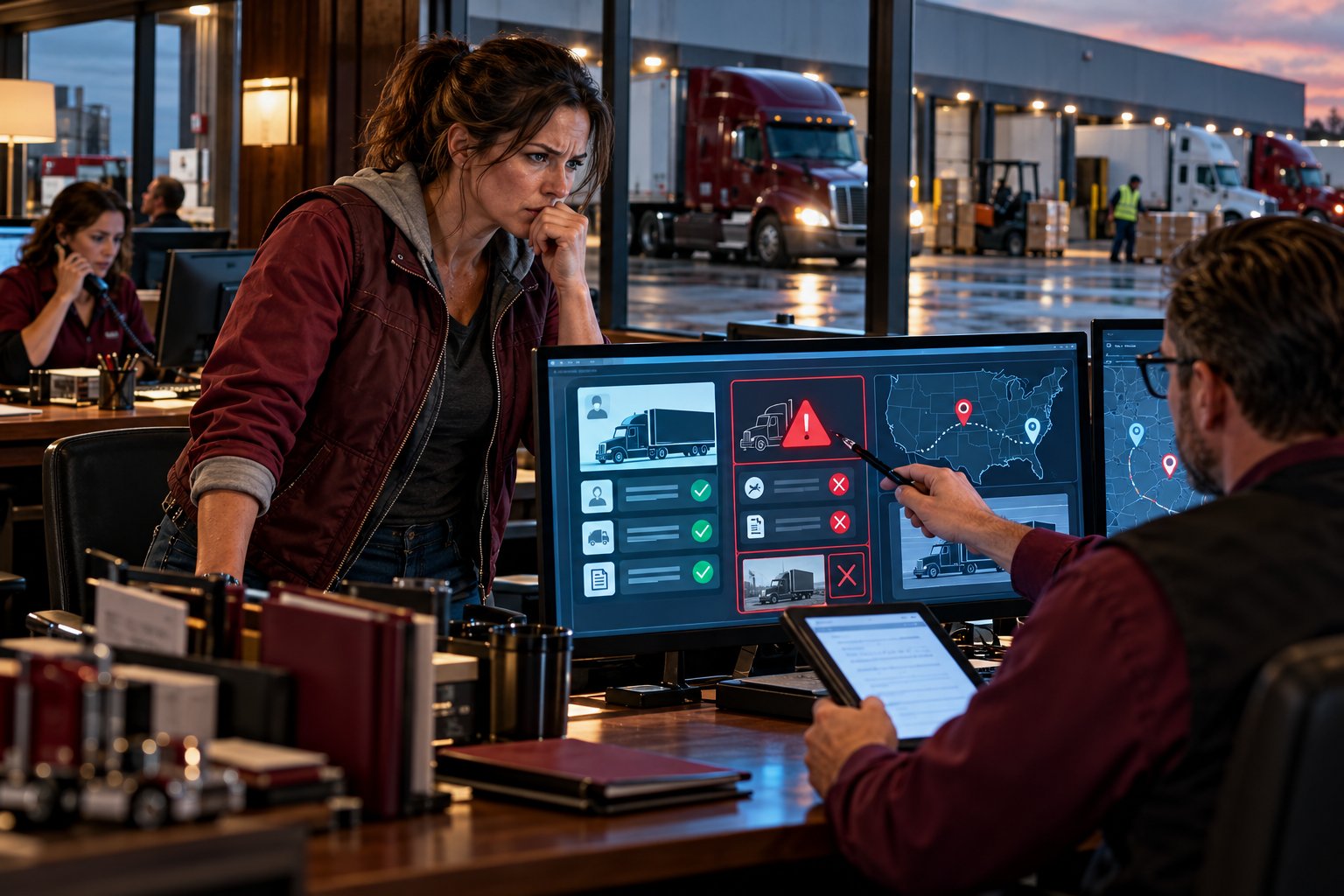
A carrier vetting process should be practical enough for a dispatcher to follow while covering multiple loads.
Start by collecting the legal company name, MC Number, USDOT Number, business contact information, insurance documents, and completed carrier packet.
You may not have the driver or tractor details when the initial offer is made.
Those can be confirmed closer to pickup, but the carrier itself must be approved before the rate confirmation and sensitive shipment information are released.
1. Verify MC and DOT Numbers in FMCSA Databases
Start with the registered business.
The Federal Motor Carrier Safety Administration maintains official registration and safety information for regulated transportation companies.
The Motor Carrier (MC) Number is associated with an operating authority docket.
The USDOT Number identifies the company in federal registration and safety records.
What to do
-
Open the MC Look Up carrier search.
-
Enter the MC Number provided by the dispatcher.
-
Review the legal business name and linked USDOT Number.
-
Compare those details with the carrier packet.
-
Open the FMCSA SAFER Company Snapshot.
-
Search using the MC/MX Number or USDOT Number.
-
Open the matching company record.
-
Confirm the legal name, DBA, and registration details.
You can also check DOT compliance records to review the carrier's registration and available safety-related information.
What a good result looks like
The identifiers resolve to the expected company.
The legal business name can be reconciled with the W-9, carrier agreement, and insurance documents.
What to watch for
-
MC Number belongs to another business.
-
USDOT Number differs between documents.
-
Company name cannot be reconciled.
-
Registration information conflicts with the carrier's claimed operation.
-
Dispatcher provides inconsistent explanations.
A valid MC Number does not establish that the person using it works for the carrier.
Contact authentication comes later in the process.
2. Confirm Operating Authority and Insurance Filings
A USDOT registration identifies the company.
Operating authority establishes whether the business is authorized to perform particular regulated transportation activities.
Confirm the authority appropriate for the proposed load.
Check Operating Authority
-
Open the FMCSA Motus public company search.
-
Search using the verified USDOT Number or legal business name.
-
Open the correct company record.
-
Review the operating authority registrations.
-
Confirm the relevant authority type.
-
Check the current status.
For an ordinary regulated interstate property shipment transported by a for-hire motor carrier, the company should hold appropriate active Motor Carrier of Property authority.
Broker authority alone does not authorize a business to physically transport regulated freight as a motor carrier.
Some businesses hold both broker and carrier authority. Review the authority involved in the actual shipment.
Use current Motus records for registration and authority checks rather than relying solely on older Licensing and Insurance information.
What a good result looks like
The company has active authority appropriate for the transportation being offered.
What to watch for
The required authority is revoked, pending, inactive, or associated with another business.
Do not rely on a promise that the company's authority will become active before delivery.
Verify insurance
Review the applicable federal financial responsibility filings.
Then examine the Certificate of Insurance supplied during onboarding.
The COI is a summary of insurance information. It does not replace confirmation from the insurer or the actual policy terms.
What to do
-
Review the required financial responsibility filing.
-
Compare the named insured with the registered motor carrier.
-
Check policy effective and expiration dates.
-
Review liability and cargo coverage limits.
-
Obtain the insurance agency's contact information independently.
-
Confirm the policies through the agent or insurer.
-
Ask whether the proposed commodity and shipment value are appropriately covered.
Ordinary general freight motor carriers are not subject to the same federal cargo insurance filing requirements as household goods carriers.
That makes shipment-specific cargo insurance confirmation important during onboarding.
What a good result looks like
The required federal filings are current, and the carrier's verified insurance arrangements satisfy the relevant shipment requirements.
What to watch for
The insurer cannot confirm the policy, the named insured differs from the approved carrier, or important cargo coverage questions remain unresolved.
Leave the carrier pending until the insurance discrepancy is addressed.
3. Audit Physical Address, Phone Numbers, and Domain Age
This step establishes whether the booking contact is connected to the registered carrier.
A person's ability to provide accurate FMCSA information does not establish that relationship.
Much of the information is publicly available.
Check the business address
Compare the carrier's registered location with the W-9, carrier agreement, and onboarding documents.
A mailing address may differ from the principal business location.
Small carriers may operate from shared commercial facilities.
Those arrangements are not automatically suspicious.
Investigate unexplained differences rather than expecting every carrier to operate from a large terminal.
Check the telephone number
Find an established business contact through reliable independent sources.
Call the carrier.
Ask whether the dispatcher is authorized to accept freight.
If a third-party dispatch service is involved, have the motor carrier confirm that arrangement.
Review the email domain
Look at the complete sender address.
Compare it with the established company domain or previously verified contacts.
Be alert for extra words, missing letters, unexpected Reply-To addresses, and recent changes.
Consider domain age when relevant
Public domain registration information may help establish when a domain was created.
A recently registered domain claiming to represent a long-established trucking company may justify additional questions.
It does not prove fraud.
Legitimate businesses create new websites and change email providers.
An old domain is also not proof that the current sender is authorized.
Make the verification call
-
Contact the carrier through an independently established number.
-
Identify the dispatcher requesting the load.
-
Ask whether that person is authorized.
-
Confirm the company expects to perform the transportation.
-
Verify the email address being used.
-
Record the representative's name and the time of confirmation.
What a good result looks like
The actual carrier confirms the dispatcher and the proposed transportation arrangement.
What to watch for
The carrier does not recognize the contact or denies accepting the load.
Do not send additional pickup information until the identity issue is resolved.
4. Implement Mandatory Check-In and Rate Confirmation Protocols
Federal verification establishes the company's registration and authority.
Your dispatch process must connect that company to the actual shipment.
The Rate Confirmation should identify the correct contracting carrier and agreed transportation details.
It should not be treated as independent proof that the recipient is authorized to act for that company.
Before sending the Rate Confirmation
Confirm that:
-
Onboarding is complete.
-
Appropriate operating authority is active.
-
Insurance requirements are satisfied.
-
The dispatch contact is authenticated.
-
The contracting carrier is correctly identified.
-
Applicable restrictions on unauthorized rebrokering are understood.
-
Sensitive pickup information will be sent only through approved channels.
Do not release pickup references before completing the required identity checks.
Before pickup
Ask the approved carrier to confirm the assigned equipment and driver when available.
Collect:
-
Driver name.
-
Tractor number.
-
Trailer number where applicable.
-
Pickup appointment.
-
Approved dispatch contact.
-
Any known equipment changes.
Send the relevant approved carrier details to the shipper.
At pickup
The shipper should compare the arriving truck and driver with the approved transportation arrangement.
If another company appears, loading should stop until your brokerage confirms the change through the approved motor carrier.
A pickup number alone is not sufficient verification.
During transit
Follow the check-in schedule established for the shipment.
Depending on the load, check-ins may include pickup confirmation, location updates, appointment changes, and delivery status.
One missed call does not establish double brokering.
Drivers may lose mobile reception or encounter routine delays.
Investigate when communication problems occur alongside unexpected equipment, carrier, or routing changes.
After delivery
Compare the final documents with the approved carrier record.
Review:
-
Bill of lading.
-
Proof of delivery.
-
Carrier invoice.
-
Payment instructions.
-
Factoring information where applicable.
-
Unexpected business names.
If another company appears on the paperwork, investigate before approving payment.
Under 49 CFR 371.3, property brokers must retain specified transaction records for three years.
What a good result looks like
The approved carrier, pickup details, delivery paperwork, and payment instructions can be reconciled.
What to watch for
An unrelated company appears on the delivery documents without an authorized arrangement explaining its involvement.
How Automated Lookup Tools Streamline Fraud Detection

Checking carriers manually often involves opening several federal databases and comparing information across multiple documents.
That works, but it becomes harder when dispatchers are screening several carriers for different loads.
Automated lookup tools can help organize the initial review.
MC Look Up provides searchable carrier profiles containing registration information, operating authority details, insurance-related records, safety information, and crash history.
A broker can use those records to identify discrepancies that need attention before approving the carrier.
The lookup supports verification. It does not replace the independent callback or establish who will actually collect the freight.
What Automated Carrier Screening Can Check
Depending on the platform and available records, automated screening may help identify:
-
Current operating authority information.
-
Insurance filing details.
-
Changes in carrier registration.
-
Available inspection records.
-
Crash history.
-
Safety-related findings.
-
Inconsistent business information.
-
Shared addresses or contact details.
-
Patterns that may warrant further investigation of related carriers.
For example, an automated search may show that a company has an established operating history and active authority.
That helps establish the registered company's status.
But if someone is impersonating its dispatcher, the federal record may still look perfectly normal.
The impersonator is using a real carrier's credentials.
That is why the booking contact must be authenticated separately.
What Automated Tools Cannot Confirm Alone
A carrier lookup does not independently establish every detail of the current shipment.
It generally cannot confirm that:
-
The dispatcher is an authorized employee or agent.
-
The company accepted the specific load.
-
The assigned tractor belongs to the approved transportation arrangement.
-
A driver substitution was authorized.
-
No undisclosed intermediary has taken control of the shipment.
-
Every relevant cargo insurance exclusion has been reviewed.
-
A changed payment instruction belongs to the correct business.
Those checks require direct communication and supporting documents.
A trust score can help identify records worth reviewing.
It should not be treated as a guarantee against fraud.
Do not confuse safety performance with identity verification.
FMCSA safety ratings, inspection records, and Safety Measurement System information primarily address transportation safety.
They do not establish whether a particular load has been double brokered.
A carrier with a satisfactory operating history may still have its identity misused by another party.
Build Fraud Checks Into Your Dispatch Workflow
Use automated tools for the checks they perform well, then assign the remaining verification tasks to a person.
At initial onboarding:
-
Verify the business identity.
-
Review MC and USDOT records.
-
Check operating authority.
-
Confirm insurance information.
-
Review available safety records.
-
Investigate material discrepancies.
-
Authenticate the dispatch contact.
Before each new booking:
-
Confirm there has been no material authority change.
-
Review shipment-specific insurance needs.
-
Verify unexpected dispatch contact changes.
-
Establish which carrier will haul the load.
-
Approve the transportation arrangement before releasing pickup information.
At pickup:
-
Confirm assigned equipment.
-
Give the shipper approved carrier details.
-
Require authorization for substitutions.
After delivery:
-
Review transportation documents.
-
Investigate unfamiliar business names.
-
Verify payment changes independently.
-
Save the required transaction records.
Keep approval status visible to everyone involved in dispatch.
A note buried in an old email is not useful when another employee takes over the load.
The person tendering freight should know whether the carrier is approved, pending, or rejected.
Common Mistakes That Allow Double Brokering
Most missed risks arise when one type of verification is mistaken for another.
1. Assuming a valid MC Number proves the dispatcher is legitimate
An MC Number identifies the registered company.
It does not prove that the sender represents that business.
Complete the independent callback.
2. Accepting a COI without confirming the policy
A forwarded certificate may be outdated or altered.
Verify relevant coverage through the issuing agent or insurer.
3. Sending pickup references before approval
Do not provide sensitive pickup information to a contact whose identity has not been established.
4. Ignoring an unexpected email change
A legitimate dispatcher may change email addresses.
Confirm the change through the motor carrier before sending load documents to the new address.
5. Treating a low rate as definitive fraud evidence
A low quote can have legitimate business reasons.
Look at the full combination of identity, authority, documents, and booking behavior.
6. Assuming every new carrier is suspicious
Limited operating history creates uncertainty, not proof of wrongdoing.
Apply the same identity, insurance, and authority checks consistently.
7. Failing to give the shipper approved carrier details
The shipping office needs to know which company is authorized to collect the freight.
Provide an escalation procedure for mismatches.
8. Approving substitutions without confirmation
Replacement trucks and drivers are common.
Verify the change with the approved carrier before loading.
9. Relying only on a trust score
A score cannot authenticate the dispatcher or establish who actually arrived at pickup.
Review the underlying records and complete operational checks.
10. Accepting new payment instructions without verification
Changes to bank details or factoring arrangements should be confirmed through an established business contact.
Do not rely only on the email requesting the change.
What to Do if You Suspect Double Brokering
A suspected unauthorized transfer requires a response based on where the freight is located.
The steps differ depending on whether pickup has occurred.
Preserve the available evidence, separate confirmed facts from assumptions, and avoid continuing to share sensitive information with an unverified contact.
If the Load Has Not Been Picked Up
Place the shipment on hold.
Contact the approved motor carrier through independently established information.
Ask whether the company accepted the load and authorized the booking dispatcher.
Confirm the assigned equipment and driver.
Notify the shipper that pickup authorization is pending.
Do not release freight solely because a driver has the pickup reference or rate confirmation.
If the carrier cannot confirm the transportation arrangement, resolve the issue before loading.
If Freight Has Already Been Collected
Contact the shipper and verified carrier immediately.
Determine which company collected the shipment.
Review:
-
Driver identity.
-
Tractor and trailer details.
-
Pickup time.
-
Shipping documents.
-
Dispatch communications.
-
Destination instructions.
-
Available shipment location information.
Ask the approved carrier whether it recognizes the driver and equipment.
Preserve the relevant communications and documents.
Follow your organization's incident response and insurance notification procedures.
If the evidence indicates possible cargo theft or criminal impersonation, contact appropriate law enforcement promptly.
Do not rely solely on the questionable dispatch contact to establish the freight's location.
If the Load Was Delivered but the Carrier Was Not Paid
A delivered shipment can still involve an unauthorized double brokering dispute.
The actual hauling carrier may explain that it accepted the load from another company and has not received payment.
Review the complete transaction.
Collect:
-
Carrier agreement.
-
Rate confirmation.
-
Bill of lading.
-
Proof of delivery.
-
Invoices.
-
Dispatch emails.
-
Payment records.
-
Factoring instructions where applicable.
Establish which businesses contracted with one another and what transportation was performed.
Do not assume the party demanding payment is automatically entitled to receive it from your brokerage.
Payment responsibility depends on the agreements and circumstances.
Refer disputed claims to the appropriate accounting, claims, or legal personnel before processing conflicting invoices.
Where to Report Suspected Freight Fraud
FMCSA provides reporting information for broker and carrier fraud, including misuse of USDOT and operating authority credentials.
Relevant reporting channels include:
-
FBI Internet Crime Complaint Center for suspected internet-enabled criminal fraud.
-
USDOT Office of Inspector General Hotline for appropriate transportation-related fraud reports.
-
Local law enforcement for suspected cargo theft or other criminal conduct.
Depending on the incident, notify relevant insurers, load boards, and factoring companies.
Include the known facts in any report:
-
Carrier identifiers.
-
Shipment details.
-
Pickup and delivery information.
-
Suspicious contact information.
-
Copies of relevant communications.
-
Timeline of events.
-
Verification steps already completed.
Avoid presenting an unresolved suspicion as a confirmed finding.
Clear documentation helps investigators understand what happened and which information still requires verification.
A Daily Carrier Vetting Routine for Freight Brokers
The best carrier verification routine is one that works on a busy dispatch desk.
Keep it consistent and assign responsibility for approval.
Before booking:
-
Identify the legal motor carrier.
-
Verify the MC and USDOT Numbers.
-
Confirm appropriate active operating authority.
-
Review insurance filings and relevant coverage.
-
Examine available safety and registration information.
-
Authenticate the dispatcher.
-
Establish who will physically haul the load.
Before pickup:
-
Confirm the correct Rate Confirmation.
-
Request driver and equipment details when available.
-
Send approved carrier information to the shipper.
-
Require verification of substitutions.
-
Confirm pickup under the approved arrangement.
During and after transportation:
-
Follow the agreed check-in schedule.
-
Investigate unexplained communication or tracking discrepancies.
-
Review pickup and delivery documents.
-
Verify unusual payment changes.
-
Save the transaction record.
Recheck established carriers when material information changes.
A carrier approved months ago may have changed insurance providers, dispatch personnel, or authority status.
Set a review schedule based on your brokerage's risk policy and shipment requirements.
For a small brokerage, a shared checklist with a named approval owner is often more useful than a complicated process that dispatchers bypass during busy periods.
Before issuing a load, someone should be able to answer one question clearly:
Who verified that this carrier is authorized, insured, and actually responsible for transporting the freight?
Frequently Asked Questions About Freight Fraud
What is the difference between legal co-brokering and unauthorized double brokering?
Co-brokering generally involves properly authorized brokers working together under an arrangement with the necessary permission, disclosure, and defined responsibilities. Unauthorized double brokering involves an improper transfer of freight to another party without the required authorization or contrary to the applicable agreement. The distinction depends on the authority, contracts, and actual roles of the businesses involved.
How do scammers obtain and misuse legitimate MC numbers?
MC Numbers and USDOT Numbers are publicly accessible through federal registration records, so an impersonator can copy legitimate carrier information. The person may use similar-looking email domains, unauthorized phone numbers, or altered carrier packets to request loads. Freight brokers should authenticate the dispatcher through an independently established carrier contact rather than trusting a valid identifier alone.
What FMCSA safety scores and indicators signal high fraud risk?
FMCSA safety ratings, SMS information, inspection violations, and crash records primarily describe transportation safety rather than whether a particular load is being double brokered. Serious operating restrictions deserve attention, but they do not independently establish freight fraud. For double brokering concerns, prioritize identity mismatches, unauthorized contacts, unexplained carrier changes, and inconsistencies between the approved motor carrier and the arriving equipment.
How can freight brokers verify insurance certificates effectively?
Compare the Certificate of Insurance with the carrier's legal identity, policy dates, limits, and shipment requirements. Contact the insurance agent or insurer through independently established information to confirm the relevant policies are active and the proposed freight is appropriately covered. Review FMCSA financial responsibility filings separately, because a COI does not replace required federal filings or guarantee coverage for every cargo loss.
The most useful double brokering checks happen before the truck reaches the dock.
Verify the company's authority and insurance, authenticate the dispatcher, and confirm which motor carrier will perform the transportation.
If a different truck, carrier, or contact appears, hold the shipment until the approved motor carrier confirms the change.
An MC Number lookup tells you which business owns the credentials. Direct contact and pickup verification help establish who is actually using them.