

Business verification services in freight logistics help a broker, shipper, dispatcher, or risk team answer a basic question before freight is tendered: is the company offering capacity the same regulated business shown in Federal Motor Carrier Safety Administration records? A useful verification process then checks authority, insurance, safety history, and transaction details so the team can spot mismatches before pickup.
The point is not to collect more paperwork. It is to connect the paperwork to the right carrier. A real Motor Carrier Number can be copied. A current Certificate of Insurance can be altered or reused. A legitimate carrier name can appear in a fraudulent email. Good verification tests whether the name, identifiers, contacts, authority, insurance, and actual truck all belong together.
What Are Business Verification Services in Freight Logistics?

In freight, business verification services are the tools and review steps used to confirm the identity and current status of a carrier or broker before a transaction moves forward. They typically combine public FMCSA records with an internal onboarding process so the reviewer can compare what the company submitted against what federal records show.
The strongest use case is carrier onboarding. A Freight Broker may receive a packet that includes a legal name, DBA, USDOT Number, Motor Carrier Number, Certificate of Insurance, dispatch contacts, and payment information. None of those fields should be reviewed in isolation. The practical question is whether they point to one coherent business identity.
A routine verification review usually covers:
- Legal name and any DBA used in the market
- USDOT Number and Motor Carrier Number tied to the entity
- Operating Authority and the type of authority shown
- Physical and mailing addresses in federal records
- Carrier insurance verification, including relevant FMCSA filings and the COI supplied for onboarding
- Inspection, out-of-service, crash, and safety rating information available through FMCSA systems
- Contact, ownership, or operating relationships that deserve manual review
The SAFER Web Company Snapshot is one of the core public sources. It can be searched by USDOT Number, MC or MX Number, or company name and provides identification, operating, inspection, crash, and safety rating information when available.
Verification Is an Identity Check Before It Is a Compliance Check
A carrier can have active authority and still be the wrong carrier for the transaction in front of you. That sounds obvious, but it is where many rushed reviews fail. The reviewer sees a valid USDOT Number, recognizes the company name, and moves on without checking whether the person who sent the packet actually represents that business.
Start with identity. Compare the legal name, DBA, USDOT Number, MC Number, physical address, phone information, email domain, insurance name, and the information on the rate confirmation. One small formatting difference is normal. Several unrelated differences are not something to wave through because a pickup appointment is close.
For example, a packet might show the correct legal carrier name and MC Number, while the dispatch email comes from a newly created public email account and the payment instructions name another entity. Each item can look plausible on its own. Together, they create a reason to stop and verify the relationship using contact information obtained independently.
That is the practical value of business verification services. They reduce the time spent moving between separate systems and make side-by-side comparison easier. The reviewer can focus on inconsistencies instead of manually rebuilding the carrier record from scratch every time.
The Anatomy of Freight Fraud and Chameleon Carriers
Freight fraud often relies on real information used in the wrong context. A bad actor may use a genuine carrier name, a real MC Number, public address data, or a copied insurance certificate. The false part may be the dispatch contact, bank account, pickup instructions, or identity of the carrier that actually arrives for the freight.
That is why simple existence checks are weak. Confirming that an MC Number exists does not confirm that the sender controls that authority. Confirming that a company has insurance does not prove that a PDF was issued for the current policy. Fraud prevention works better when the reviewer checks the relationship between the carrier record and the people, documents, and equipment involved in the specific load.
FMCSA publishes practical fraud guidance for brokers and carriers, including the need to verify documents and confirm identities through more than one source. See FMCSA Broker and Carrier Fraud and Identity Theft.
How Chameleon Carriers Evade FMCSA Oversight
A Chameleon Carrier is generally understood as a motor carrier that attempts to continue operations through a new or affiliated entity after problems attach to a prior carrier. FMCSA can examine relationships between entities when it evaluates possible reincarnation or affiliation.
For a brokerage, chameleon carrier detection is a screening task, not a legal conclusion. The goal is to notice continuity that deserves a closer look. A new carrier may legitimately share an address, family ownership, office staff, equipment, or customers with an older business. The concern rises when those overlaps appear alongside an unexplained attempt to distance the new entity from a prior record.
Useful indicators include:
- A recently created carrier uses the same business location, phone number, email domain, or management contact as an older carrier with material safety or enforcement history.
- The legal name changes, but equipment, drivers, operating location, or key contacts appear substantially continuous.
- An older entity becomes inactive or out of service and a closely related entity appears soon afterward.
- The onboarding contact gives conflicting answers about ownership, prior operating names, or related companies.
The useful review is cumulative. A shared terminal address on its own may mean very little. A shared address, shared phone number, overlapping management contact, similar operating profile, and unexplained prior history deserve a different level of attention.
Keep notes on what was matched and why the relationship was cleared or escalated. If the same carrier returns later, the next reviewer should not have to rediscover the entire relationship from the beginning.
Double Brokering Schemes and Identity Theft Risks
Double Brokering usually involves freight being passed to another carrier without the original broker or shipper knowing that the contracted carrier will not perform the haul. The result can be more than an administrative problem. Payment disputes, cargo control issues, and uncertainty about who actually had custody of the load can follow.
Identity theft creates a related risk. A fraudster can impersonate a legitimate motor carrier, use its public MC and USDOT information, copy a logo, and send an altered COI or rate confirmation. A carrier lookup may confirm that the carrier is real, but that still does not prove the sender is authorized to act for it.
During onboarding, pay close attention to changes that affect identity or control of the transaction:
- The email address does not match the carrier domain or the contact pattern already associated with the business.
- A new phone number, dispatch contact, bank account, or factoring instruction appears without an independently verified explanation.
- The carrier packet names one company while the COI, rate confirmation, invoice instructions, or email signature names another.
- The contact asks the broker to bypass normal verification because the truck is already close to pickup.
- The driver is instructed to identify as a different carrier at pickup or delivery.
When a material detail changes, verify the change using a source you already trust or contact information obtained independently. Calling the number supplied in the suspicious email simply sends the verification back to the same source you are trying to verify.
At pickup, transaction-level verification matters too. The truck, driver, carrier name, and dispatch details should make sense against the carrier that was approved. A clean onboarding record does not help if a different company appears for the freight and nobody checks the substitution.
Essential Verification Checks for Secure Carrier Onboarding
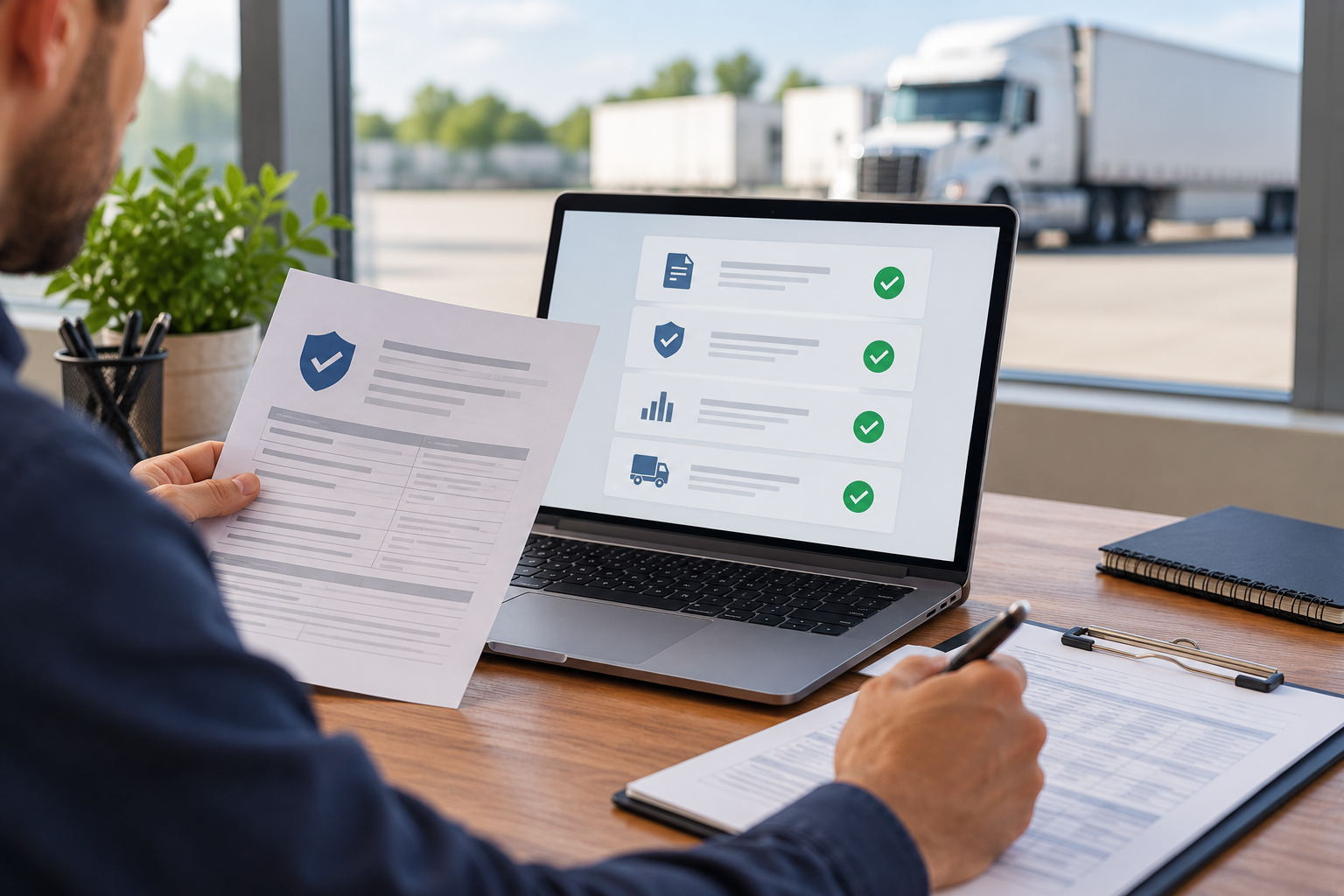
Secure Carrier Onboarding is easier to manage when the team separates three questions. First, is this the correct business? Second, does the business have the authority and financial responsibility relevant to the proposed work? Third, does the available safety record fit the broker or shipper's risk policy?
Keeping those questions separate prevents a common mistake: allowing one positive field to compensate for a problem elsewhere. Active authority does not cure an identity mismatch. A familiar carrier name does not cure inactive authority. A COI does not replace a check of current FMCSA filings.
FMCSA Operating Authority and DOT Lookups
Start with the USDOT Number and MC Number supplied by the carrier. The USDOT Number is the key identifier used in FMCSA safety records. The MC Number is associated with certain types of Operating Authority for regulated interstate for-hire operations. Both should resolve to the legal entity you intend to onboard.
In the SAFER System, confirm the legal name, DBA if any, physical address, USDOT status, and operating information. Then compare those fields with the packet, COI, W-9 information, rate confirmation, and contact details in your own system.
Read authority status in context. A company can appear in FMCSA records without having the type of authority needed for the transaction you are considering. For an interstate for-hire property movement, the authority should fit the role the company says it will perform.
A second practical check is timing. A carrier packet saved months ago may still show information that was correct when it was collected. Before booking a new load, verify the current public record rather than relying on the old packet as the source of truth.
Automated data checks are useful here because they reduce dependence on stale documents. They can surface a changed authority status or record mismatch for review. They do not replace judgment, but they make it harder for a material change to hide in a file that nobody reopened.
Carrier Insurance Verification and Policy Status
Carrier insurance verification has two parts. First, review the federal insurance filings relevant to the carrier's authority. Second, review the Certificate of Insurance against your brokerage or shipper requirements. These are related checks, but they are not the same check.
FMCSA publishes the federal filing framework in its FMCSA Insurance Filing Requirements guidance.
For motor carriers, public liability filings are commonly associated with bodily injury and property damage, often shortened to BIPD. Cargo filing requirements differ by operation. A federal cargo filing is not required for every general property carrier, so the absence of that filing should not automatically be treated as proof that a general freight carrier lacks cargo coverage.
That distinction matters in day-to-day onboarding. Your brokerage may require cargo insurance contractually even when a federal cargo filing is not required for that carrier type. In that case, the COI is part of your coverage review, while FMCSA filings are part of the authority and financial responsibility review.
Do not accept a COI simply because it looks professional. Check the insured name, policy dates, coverage descriptions relevant to your requirements, producer information, and any obvious mismatch with the carrier record. If something changed unexpectedly, verify through independently sourced insurer or producer contact information where appropriate.
- Confirm the insured business name matches the carrier being onboarded.
- Compare policy dates with the planned load date and your internal requirements.
- Review whether cancellation or replacement filing information is relevant to the carrier record.
- Verify suspicious changes through independently sourced contact information rather than contact details supplied only in the changed document.
- Record what was checked and when so another reviewer can understand the approval later.
The point is consistency. A COI, a federal filing, and an onboarding packet should tell a compatible story about the same business. When they do not, resolve the discrepancy before the load moves.
Safety Ratings, Inspection History, and Crash Records
Carrier compliance review should include available safety information, but raw counts need context. The SAFER snapshot can show inspection activity, out-of-service results, crash involvement, and a federal safety rating when one exists. FMCSA crash data records involvement in reportable crashes. It does not assign fault for each crash.
FMCSA describes these public data sources in FMCSA Company Safety Records.
Look at the operating profile before drawing conclusions. A larger carrier may have more inspections and crash records simply because it operates more trucks and miles. A very new or small carrier may have little inspection history, which does not make it unsafe, but it gives the broker less public history to evaluate.
The practical review is comparative. Check fleet size, inspection history, out-of-service information, crash involvement, and safety rating together. Then compare what you see with your own documented thresholds and the risk of the freight being tendered.
Recent changes matter too. If a carrier that normally presents a stable record suddenly shows a material status change, treat that as a new review event. Do not assume the original onboarding decision remains valid just because the company has hauled for you before.
Carrier verification checklist
| Check | What to verify | Why it matters | Escalate when |
|---|---|---|---|
| Identity | Legal name, DBA, USDOT Number, MC Number, address, contact details | Confirms the party offering capacity maps to the regulated business | Identifiers point to different entities or contact changes cannot be explained |
| Authority | USDOT status and relevant Operating Authority | Confirms the record supports the service being offered | Authority is inactive, out of service, or inconsistent with the proposed operation |
| Insurance | Federal filings, COI, policy dates, insured name, internal coverage requirements | Separates federal filing review from contractual coverage review | Names, dates, filings, or producer information do not align |
| Safety | Inspections, out-of-service information, crash involvement, rating if any | Adds operating history to the identity and authority review | Material issues fall outside documented risk thresholds or require management review |
| Fraud signals | Contact changes, related entities, pickup identity, truck and driver details | Helps surface impersonation, double brokering, or possible chameleon behavior | The company or equipment at pickup does not match what was approved |
Best Practices for Mitigating Risk During Carrier Onboarding
Good onboarding does not need dozens of disconnected checks. It needs a fixed sequence that reviewers follow even when the load is urgent. The weak point in many workflows is inconsistency: one carrier gets a full review, while another is approved because the name is familiar or the dispatcher says the truck is already nearby.
A repeatable workflow also makes training easier. New team members can see which fields are mandatory, which mismatches require escalation, and which changes need independent verification. That reduces the chance that a persuasive email or a rushed pickup changes the standard of review.
Use a Fixed Order of Operations
Start with identity, then authority, then insurance, then safety, then transaction-specific fraud checks. That order matters. There is little value in studying a carrier's crash history before confirming that the record belongs to the company asking for the load.
- Identify the legal carrier using the company name, USDOT Number, and MC Number.
- Confirm the physical address, DBA, and contact information against the onboarding documents.
- Review FMCSA Operating Authority and USDOT status for the proposed operation.
- Check relevant federal insurance filings and compare the COI with your contractual coverage requirements.
- Review inspections, out-of-service information, crash involvement, and safety rating data when available.
- Verify pickup contact, truck, driver, and carrier identity when the freight or transaction risk warrants it.
- Document material discrepancies and the reason they were cleared, escalated, or rejected.
MC Look Up helps freight teams perform fmcsa carrier verification by bringing carrier identity, DOT data, authority information, crash records, insurance status, and other vetting signals into a faster review workflow.
Standardization also helps with handoffs. If the night team starts onboarding a carrier and the day team finishes it, both reviewers should be able to see which checks were completed and which issue is still open. A short written note about an address mismatch is more useful than a vague status such as “looks fine.”
Verify Changes, Not Just Initial Applications
Carrier risk changes over time. Authority can change. Insurance filings can change. Contact information can change. A carrier that passed onboarding months ago should not automatically be treated as unchanged when it returns for a new load.
Build re-verification around events that matter. Examples include a carrier returning after a long gap, a new dispatch email, a changed phone number, different payment or factoring instructions, a replacement COI, a new DBA, or an unfamiliar driver arriving under a carrier name your team knows well.
A change is not proof of fraud. It is a reason to confirm the new information before relying on it. If a known carrier suddenly asks to send payment somewhere new, verify the request through a previously established contact channel. If the physical address changed, compare the updated FMCSA record and onboarding documents rather than assuming the old address is still correct.
Scheduled rechecks should fit the brokerage's freight profile, customer requirements, risk tolerance, and internal carrier compliance process. High-value, theft-sensitive, or unfamiliar freight may justify tighter review than a routine transaction with a well-established carrier whose current records still match your files.
Separate Automated Flags From Human Decisions
Automation is good at finding changes. It is less good at explaining them. A changed address, a new DBA, a replaced insurance filing, or a related business can all be legitimate. The system should surface the fact. A reviewer should decide what the fact means in the context of the carrier and the load.
Use clear escalation rules. An inactive authority may stop the booking until the status is resolved. A changed phone number may require independent contact verification. A carrier linked to an older entity with negative history may need management review. A minor punctuation difference in the legal name should not trigger the same response.
This separation prevents two bad outcomes. The first is alert fatigue, where reviewers ignore flags because everything is marked high risk. The second is false confidence, where a clean automated result is treated as a guarantee. Good freight fraud prevention uses automation to focus attention, then applies human judgment to the exceptions.
Keep the final decision tied to evidence that can be reviewed later. If a mismatch was cleared, note how it was verified. If a carrier was rejected, record the operational reason in neutral terms. That creates a more defensible and more consistent onboarding process without turning the verification tool into a substitute for policy.
Frequently Asked Questions About Carrier Verification
What is a chameleon carrier in trucking?
A chameleon carrier is generally a motor carrier that appears to continue operations through a new or affiliated entity after problems attach to a prior carrier. Shared ownership, addresses, contacts, equipment, or operating patterns can justify further review, but those links do not prove reincarnation by themselves.
How do business verification services detect fraudulent carriers?
Business verification services compare identity, USDOT and MC records, authority, insurance status, safety information, and related business details to find inconsistencies. They can surface issues such as a mismatched legal entity, changed contact information, inactive authority, or suspicious relationships, but a reviewer may still need to determine whether the discrepancy has a legitimate explanation.
What key records must be verified before booking a motor carrier?
Verify the legal name or DBA, USDOT Number, Motor Carrier Number when applicable, Operating Authority, physical address, relevant insurance filings, and available safety and crash information. Also compare the approved carrier identity with the dispatch contact, driver, truck, and pickup details used for the actual load.
How does automated FMCSA data checking prevent double brokering?
Automated FMCSA checking can quickly show whether the carrier identity, authority, and current public record match the company offering capacity. It cannot prevent every double brokering scheme, but it reduces dependence on static packets and makes material identity or status changes easier to catch before freight is released.
How often should a freight broker re-verify carrier compliance?
There is no single interval that fits every brokerage or every load. Recheck when material information changes, when a carrier returns after a meaningful gap, and on a schedule that fits your internal policy, customer requirements, freight sensitivity, and exposure to fraud.
Business verification services are most useful when they turn carrier vetting into a repeatable evidence check. MC Look Up helps brokers, dispatchers, shippers, and risk teams compare carrier identity, FMCSA status, authority, insurance information, crash records, and other signals before freight is tendered. No verification process eliminates fraud, but a consistent review gives the team a clearer reason to approve a carrier, investigate a discrepancy, or stop the transaction before pickup.